About Adam Young

Once upon a time I was an Army Officer, but that was long ago. Now I work as a Software Engineer. I climb rocks, play saxophone, and spend way too much time in front of a computer.

BProc 5.0 is in Git

Penguin Computing has graciously provided their version of BProc to the
project. Special Thanks goes to John Hawkes, the Director or Software
Engineering and Andreas Junge VP of Engineering at Penguin for making this
happen. In the next couple of weeks, we’ll work at getting some packages
made from the code and posted on the files portion of the Sourceforge
site.

The code is targeted at a RHEL 5.4 Kernel, due to development priorities
at Penguin. Expect to see a set of RPMs for the Kernel and the userland
codes for the unified process space code.

For now, we are going to focus on the kernel side of development. Our
goal is to get the necessary changes into the upstream Kernel. We will
begin work shortly on a version of BProc that targets the current
development Linux Kernel.

As such, the beoboot and related code is going to be left untouched in the
CVS tree.

The Git Repository is live here:

http://bproc.git.sourceforge.net/git/gitweb-index.cgi

Expect it to go through some changes in the future as we get it cleaned up
and ready for distribution.

I still have an emergency hold on all email traffic to this list due to
the high percentage of SPAM. I will pass through all message that come
from real human beings, and that are regarding the BProc code base.

The code is very different from the last released version of bproc 4.0. I
will post more details in the future about how to get a Kernel built, why
we made the decisions we did, and what the plan is for the future. I am
very excited about this project, and hope to get some community momentum.

Thanks Again to everyone who made this happen.

My Grandfather’s Flag

The Following post was written by my Mother.

My Grandfather's Flag

My Grandfather's Flag

To the best of my knowledge, my father was given the flag while he was still in the army. He was not discharged immediately after the war but spent many years in the reserves. I remember him packing to leave for Camp Drum, as it was called in those days. He was not called up for Korea, but I think he was still in then because I can remember him going to camp for two weeks every summer for several summers. I was too young to remember him going in Ohio, and we moved to Merrick in 1949. I would have been too young to remember many summers when Korea broke out in 1950.

I remember him saying that when the war ended in Europe, they were preparing to go to the Pacific. As they were about to depart, the war ended in Japan. He said they then sailed back to NY, instead, and upon entering NY Harbor, they all through their mess kits overboard.

He became active in some military organizations. In Merrick the more active group was the American Legion, vastly different from what it has become today, a drinking, non-tipping hangout. He was an officer in that post. I am not sure which group gave him the flag, the VFW or the Legion, or the government. I remember him marching in some parades in Merrick on Memorial Day and Veterans (Armistice) Day, and they were a big group. The VFW post was, I think, in Freeport.

He won several medals which we played with, broke, lost. We were children, and he didn’t mind.

He didn’t keep up with any of the men he served overseas with but did with some of his reserve buddies.

Although he is not buried with that rank, he had told us that he was Chief Master Sargeant. I don’t know what that rank actually is. Maybe it was honorary. The chevron on his arm had lots of stripes and something in the middle. I think he is buried as a First Sgt.

As you know, his name is engraved on the memorial at Silver Lake in Baldwin. His name is spelled wrong, two L’s instead of one.

Grandpa always flew the flag on holidays. I continue to fly his flag for him and for all the men and women who have served in defence of this country. That includes just about every male member of my family–except your father. I only fly his flag on special holidays like Memorial Day, Independence Day, and Veterans Day.

Uncle Gene has the flag that was presented to me at his funeral. I gave it to Uncle Gene because, like his father, he served. I would have loved to give it to you, but I thought Gene really deserved it. I will give you this 48 star flag. It is older and signifies much more. And, of course, it was definitely before Alaska and Hawaii became states in 1959. So, for whatever the story, it really is Grandpa’s army flag. And he was proud of it.

Popup notifications

I am easily distracted. If a build takes more than say, three seconds, I usually will flip to doing something else. This means that I often miss when a build is completed, and end up losing a few minutes here, a few minute there.

Well no longer. I use Zenity! What is this you ask? I didn’t know either until today. Zenity is a command line tool for making a popup window appear.

Now My build scripts look like this:

mvn -o -Pdev install
zenity –info –text “Build is completed”

This kicks off the build, and, when it is done, I get a lovely popup window telling me: the build has completed.

As the Corollary to Murphy’s law states: If its stupid, but it works, it ain’t stupid.

Why zenity? I mean, there are at least a dozen different ways to popup a window. Well, in keeping with that Cardinal programmer virtue of laziness, it is because zenity is in the Fedora11 repo, and I am running Fedora 11. yum install is my friend.

Yes, I realize that if I were cooler, I would make my script tell me success versus failure, and pop up the appropriate window for that. I’m not that cool.

OK, I wanto to be cool. Here’s the new version:

mvn -o -Pdev install && zenity –info –text “Build is completed” || zenity –warning –text “Build Failed”

This pops up a warning message box on mvn returning non-zero for failure. Note the use of the && and the ||. The evaluation of this is kind of cool: The && (logical and) has short circuit semantics, so the second portion only gets evaluated if the first part evaluates to true. However, the || (logical or) only gets evaluated if everything before it fails.

Inigo’s Tale

(Flamenco)
Inigo:
The city of Toledo
gathered much acclaim
known for great sword makers
The best in all of Spain

The finest was  Domingo
His sword were straight and true
His family name: Montoya
That is my last name too.

One day we had a visit
From a most important man
He needed a custom foil
For his six fingered right hand

My father loved the challenge
and said he’d forge it right
for weeks he worked unstopping
from dawn to late at night

The six-fingered man demanded the saber
at one tenth the price agreed on at the start
my father refused and the six-fingered man
slashed my father right through the heart.

I loved my father dearly
he raised me to be true
though I was but eleven
I challenged him to a duel

The man he left me bleeding
with the marks you see here
That’s the last time I saw him
It has been twenty years

Twenty years of training
to duel as best I can
Twenty years of searching
For the Six Fingered man

I will find my father’s murderer
I will look him in the eye and say
Hello my name is Inigo Montoya
You Killed my Father
Prepare to Die.

Brawns, Brain, and Steel

This one is a minor I-IV-II-V number based on a melody I wrote a long time ago.  It is acappella until Fezzik starts.

Brawn, Brains and Steel

Vizzini: I was wondering if you’d help us
We’re performers from the circus
Lady up there on your horse
Can you help us find our course

How far to the closest town
Buttercup: There is none for miles around
Vizzini:There is no one near this scene
so nobody will hear you scream

Fezzik: If you want a job done right
bring along a man of might

Inigo: To bring the plan into accord
get yourself a hired sword.

Vizzini: For a plan thats circumspect
needs a cunning intellect

For proper execution you’d best combine
Fezzik:My strength
Inigo: My Sword
Vizzini: My mind

First of all you need a plan
Vizzini he is your man
If you have some heavy work
You get Fezzik, the might Turk

To protect your gotten gain
Inigo the sword from Spain
The only way to close the deal
You need brawn and brains and steel.

If you’ve a mission coming on
you need steel and brains and brawn

Highlander Syndrome in Package Management

Somewhere between systems work and application development lies the realm of package management. There are two main schools of thought in package management: inclusive or exclusive. If you are inclusive, you want everything inside a package management system, and everything should be inside one package management system. If you are exclusive, you want the system to provide little more than an operational environment, and you will manage your own applications thank-you-very-much.

One problem with the inclusive approach is, in the attempt to clean up old versions, you often end up with The Highlander Syndrome. There can be only one version of a library or binary installed on your system. The Exclusive approach is more end application focused. I may need to run a different version of Python than is provided by the system, and I don’t want to be locked in to using only the version installed system wide. In fact, I may require several different versions, and each of these require their own approach.

CPAN, Pear, and Maven have provide language specific approaches level APIs to resolving dependencies at the per application level. Maven is particualrly good at providing multiple versions of the API: I errs so far this way that often the same Jar file will exist multiple times in the maven repository, but under different paths.

There should be middle ground for the end user between all or nothing in package managemnt. As a system administrator, I don’t want users running “just any” software on their system, but as an end user I don’t want to be locked in to a specific version of a binary.

If the role of application maintainer is split from the role of system administrator, than the people that fill those two roles may have reason to use a different approach to package management. Since the app developer can’t be trusted, the sys admin doesn’t provide root access. With no root access, the app developer can’t deploy an RPM/Deb/MSI. The app developer doesn’t want the system administrator updating the packages that the app depends on just because there is a new bugfix/feature pack. So, the app developer doesn’t use the libraries provided by the distribution, but instead provides a limited set. Essentially, the system has two administrators, two sets of policy, and two mechanisms for applying that policy.

Each scripting language has its own package management system, but the binary languages tend to use the package management system provide by the operating system.  Most Scripting language programmers prefer to work inside their language of choice, so the Perl system is written in perl, the emacs system is written in LISP, the Python one in Python and so on. The Wikipedia article goes into depth on the subject, so I’ll refrain from rewritintg that here.

A Package management system is really a tuple.  The variables of that system are:

  • The binary format of the package
  • The database used to track the state of the system
  • The mechanism used to fetch packages
  • The conventions for file placement

There is some redundancy in this list.  A file in the package my also be considered a capability, as is the “good name” of the package.  A package contain empty sets for some of the items in this list. For example, an administrative package may only specify the code to be executed during install, but may not place any files on a file system. At the other extreme, a package may provide a set of files with no executable code to be run during the install process.

Of these items, it is the conventions that really prevent interoperability. This should come as no surprise:  It is always easier to write an adapter on top of an explicit interface than an implicit one. The Linux Standards Base helps, as does the standards guidelines posted by Debian, Red Hat, and other distribution providers. However, if you look at the amount of traffic on the mailing lists regarding “file X is in the wrong place for its type” you can understand why automating a cross package install is tricky.  Meta package management schemes attempt to mitigate the problem, but they can really only deal with thing that are in the right place.

Take the placement of 64 bit binaries.  For library files, Red Hat has provided a dual system:  put 32 bit libriares under /usr/lib and 64 bit libraries under /usr/lib64.  Debian puts them all into the same directory, and uses naming to keep them apart. In neither case, however, did they provide a place to make 32 and 64 bit binaries co-exist. How much easier would migration have been if we had /usr/bin32 and /usr/bin64, with a symlink from either into /usr/bin?

Thus we see a couple of the dimensions of the problem.  An application should have a good name:  web server, mail client,  and so on.  A system should support multiple things which provide this capability, a reasonable default, and customizability for more advanced users.The system should provide protection against applications with known security holes, but provide for the possibility of multiple implementations released at different points in time.

An interesting take on package management comes from OSGi.  It is a language specific package management approach, specifically for Java.  It takes advantage of portions of the the Java language to allow the deployment of multiple versions of the same package inside a since Process. When I mentioned this to some old time Linux sys admins, they blanched.  OSGi does not specify how to fetch the packages, much like RPM without YUM or DPKG  with out APT.  OSGi packages are installed into the application.  As such, they are much more like shared libraries, with specific code sections run on module load and unload.  Different OSGi container provide different sets of rules, but basically the packages must exist inside of a subset of directories in order to be available for activation.  I have heard an interesting idea that the JPackage/RPM approach and OSGi should ideally merge in the future.  To install a Jar into your OSGi container, you would have to install an RPM.

One additional issue on the Java/RPM front is Maven.  Both Maven and RPM want to run the entire build process from start to finish.  Both have the concept of a local Database of packages to resolve dependencies.  For long term Java/RPM peaceful coexistence, RPM is going to have to treat Maven as a first class citizen, the way that it does make.  Maven should provide a means to generate a spec file that has the absolute minimum in it to track dependencies, and to kick off an RPM build of the Maven artifacts.

The Princess Bride Song

Second Scene, where Humperdinck Proposes.  This expands on the movie, using some details from the book.

The Princess Bride

Buttercup, far I have traveled

I’ve ranged this domain I command

Seeking a suitable Princess

To become the Queen of the Land

In the far corner of Florin

I heard the tale of a Girl

Possessing spectacular beauty

Unrivaled in all of the world

It may be that your birth is common

But by the most noble of Arts

I see the majestic potential

Encased in you delicate Heart

Buttercup hear my decision

It took not long to decide

The law of the land shall support me

Buttercup shall be my Bride

Hear me now People of Florin

one month from this moment here

Our Country will have been founded

Exactly 500 years

At sundown of that very evening

A Lady will stand at my side

Florin will have a new Princess

And I shall take her as my bride

Not long ago she was common

In A farm house she was seen

Now you will find she’s is Noble

And Regal as befits your Queen

Would you now like to behold her

The Joy overflows from my cup

The Princess that soon I will Marry

Behold Princess Buttercup

Buttercup your heart is empty

Consumed as it were by a flame

that burnt away all your ambition

and left you with nothing but pain

I know you claim not to love me

I hope that will alter with time

Someday your pain will diminish

One day you will cease to pine

Perhaps the fault lies in this castle

solid stone walls that surround

your home was open and verdant

You may crave to travel the open ground

A breath of fresh are will revive you

Comfort will find you outside

You’ll find your horse has been saddled

Buttercup please take a ride

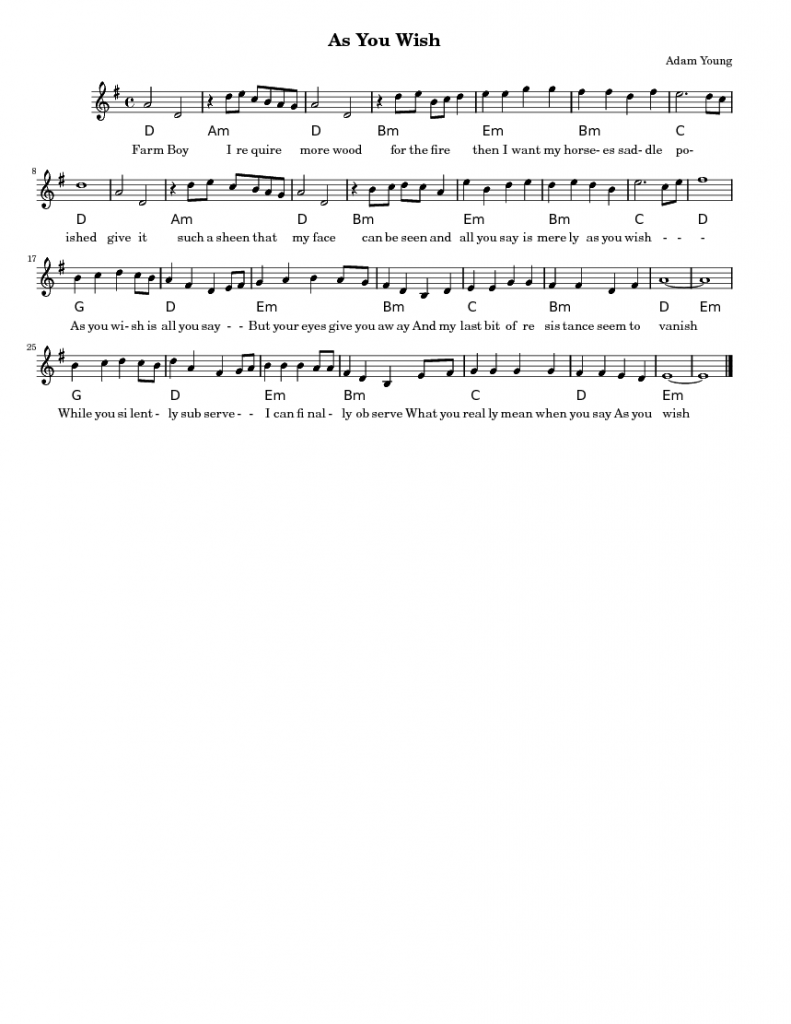
As You Wish

This is my take on the Princess Bride as a Musical. I’ve written it as a light Opera: all scenes will be sung. I have melody lines and chords for most songs.  I’ll post each number individually.

Act One, Scene One:

As you Wish

(Narrator)
Buttercup was a beauty
With but two things to enjoy
Going horseback riding
And tormenting her Farm Boy.

Buttercup: Farm boy I require
More wood for the Fire
And then my horses saddle you will polish
Give it such a sheen
My face can be seen
And all you say is simply “As you wish.”

As the seasons pass
I more gently ask
Farmboy, would you please fetch me that dish.
And as I watch your eyes
I begin to realize
There may be something in that “As you wish.”

As you wish is all you say
But your eyes give you away
And my last bit of resistance seem to vanish
While you silently subserve
I can finally observe
What you really mean when you say “As you wish.”

This trip you must take
You’re fortune for to make
“I’ll always come for you”, I hear you say
And though you say its so
I ask you how you know
“True love doesn’t happen every day.”

“As you wish” I hear you say
As I watch you sail away
The horizon makes your vessel vanish
Once your gone I will abide
Know that I will hold inside
The echo of you saying “As you wish.”

Pirates Roberts took your ship
No survivors left of it
Condemning me to live on in anguish
For my love has passed away
I will never hear you say
Your quiet phase of loving
“As you wish.”

interface2addr

This little script will give you the ipv4 address for a given network interface, or list all of them if you leave the parameter blank:

#!/bin/bash

INTERFACE=$1

/sbin/ifconfig $INTERFACE | grep “inet addr” | cut -d\: -f 2 | cut -d” ” -f 1

Call it like this:

~/bin/interface2addr eth0